
Sidak S.Y., Kaprus I.Y.
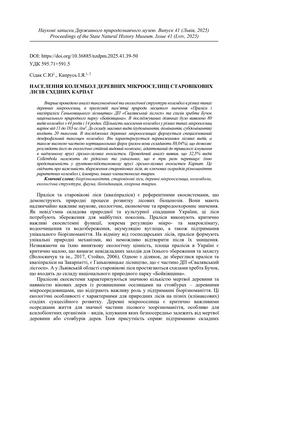
Сollembola population of woody microhabitats of old-growth forests of the Eastern Carpathians // Proc. of the State Nat. Hist. Mus. - Lviv, 2025. - 41. - P. 39-50 DOI: https://doi.org/10.36885/nzdpm.2025.41.39-50 Key words: biodiversity, old-growth forests, woody microhabitats, collembola, ecological structure, fauna, bioindication, animal protection For the first time, we analyzed the taxonomic and ecological structure of collembola in different types of tree-related microhabitats (TreMs), in the old-growth forests of local importance “Primeval and quasi-primeval forests of Gan’kovyts’ke forestry” of the State Enterprise “Svaliava Forestry” and the slopes of the Buchok ridge of the National Nature Park “Boykivshchyna”. In the studied areas, 80 species of Collembola belonging to 44 genera and 14 families were identified. The population density of Collembola in different microhabitat types ranged from 11 to 183 individuals per dm³. The group of abundant species (eudominants, dominants, and subdominants) included 20 taxa. A specialized dendrophilous taxocene of Collembola was found to form within the investigated arboreal microhabitats. It is characterized by the predominance of forest species and a high proportion of corticolous forms (together making up 88.04%), which allows it to be regarded as an ecologically stable species complex, adapted to long-term existence in the aboveground layer of mountain forest ecosystems.The analysis revealed that 32.5% of Collembola species belong to rare and unique taxa, a figure three times higher than their representation in the soil-litter layer of mountain forest ecosystems of the Carpathians. This highlights the importance of conserving old-growth forests as key refuges for the diversity of rare Collembola and, likely, other arthropod species.
Сollembola population of woody microhabitats of old-growth forests of the Eastern Carpathians // Proc. of the State Nat. Hist. Mus. - Lviv, 2025. - 41. - P. 39-50 DOI: https://doi.org/10.36885/nzdpm.2025.41.39-50 Key words: biodiversity, old-growth forests, woody microhabitats, collembola, ecological structure, fauna, bioindication, animal protection For the first time, we analyzed the taxonomic and ecological structure of collembola in different types of tree-related microhabitats (TreMs), in the old-growth forests of local importance “Primeval and quasi-primeval forests of Gan’kovyts’ke forestry” of the State Enterprise “Svaliava Forestry” and the slopes of the Buchok ridge of the National Nature Park “Boykivshchyna”. In the studied areas, 80 species of Collembola belonging to 44 genera and 14 families were identified. The population density of Collembola in different microhabitat types ranged from 11 to 183 individuals per dm³. The group of abundant species (eudominants, dominants, and subdominants) included 20 taxa. A specialized dendrophilous taxocene of Collembola was found to form within the investigated arboreal microhabitats. It is characterized by the predominance of forest species and a high proportion of corticolous forms (together making up 88.04%), which allows it to be regarded as an ecologically stable species complex, adapted to long-term existence in the aboveground layer of mountain forest ecosystems.The analysis revealed that 32.5% of Collembola species belong to rare and unique taxa, a figure three times higher than their representation in the soil-litter layer of mountain forest ecosystems of the Carpathians. This highlights the importance of conserving old-growth forests as key refuges for the diversity of rare Collembola and, likely, other arthropod species.
References
- Капрусь І.Я. 2010. Висотна диференціація таксономічного розмаїття колембол у гірських регіонах України // Наукові основи збереження біотичної різноманітності. Т. 1(8) 1. С. 235–246.
- Капрусь І.Я. 1999. Значення колембол у системі біоіндикації лісових ценозів Карпат // Праці наук. тов-ва ім. Шевченка. Львів. Т. 3. С. 235–248.
- Капрусь І.Я., Гоблик К.М. 2015. Екологічна та созологічна оцінка ґрунтів Закарпатської низовини за угрупованнями колембол. Наукові записки Державного природознавчого музею. Вип. 31. С. 45–58.
- Капрусь І.Я. 2013. Хорологія різноманіття колембол (філогенетичний, типологічний і фауністичний аспекти). Дисертація доктора наук, Інститут зоології НАН України. Київ. 497 с.
- Капрусь І.Я., Шрубович Ю.Ю., Таращук М.В. 2006. Каталог колембол (Collembola) і протур (Protura) України. Львів. 164 с.
- Критерії та методика ідентифікації пралісів і старовікових лісів (квазі-пралісів). 2017. За ред. Р. Волосянчука, Б. Проця, О. Кагала. Львів : Ліга-Пресс. 36 c.
- Кузнецова Н.А. 2005. Организация сообществ почвообитающих коллембол. Москва : ГНО Прометей. 244 с.
- Марискевич О.Г., Земан В.В. 2021. Cтаровікові ліси на території НПП «Бойківщина» (Українські Карпати). «Старовікові ліси як модель – відновлення функціональної суті карпатських лісів». (Україна, м. Львів 23-24 червня 2021 року). Тези доповідей міжнародної науково-практичної конференції. 46 с.
Департамент екології та природних ресурсів Закарпатської ОДА. 2021. Праліси та квазіпраліси Ганьковицького лісництва. Пралісова пам’ятка природи місцевого значення [online]. Доступне
- Стойко С. М. 2006. Праліси як екологічні моделі для ренатуралізації вторинних фітоценозів // Укр. ботан. журн. - Т. 63, № 3. - С. 358-268 Стебаева С.К. 1970. Жизненные формы ногохвосток (Collembola). Зоол. журн. Т. 44 № 10. С. 1437–1454.
- Bellinger P.F., Christiansen K.A., Janssens F. 1996–2023. Checklist of the Collembola of the World [online]. Доступне http://www.collembola.org [Дата звернення 14 лютого 2025 року].
- Dunger W., Fiedler H.J. (Hrsg.) 1997. Methoden der Bodenbiologie. Gustav Fischer Verlag Jena, Villengang. 539 pp.
- Gwiazdowicz, Dariusz J., Dariusz Skarżyński, Laurence Fazan, Yann Fragnière, Dany Ghosn, Gregor Kozlowski, Robert Kuźmiński, Ilektra Remoundou, and Bogna Zawieja. 2022. «Microarthropods Living on the Endemic Tree Zelkova abelicea (Ulmaceae) with Particular Attention to Collembola Diversity» Forests 13, no. 2: 195. https://doi.org/10.3390/f13020195
- Hammer I., Harper D.A.T., Ryan P.D. 2001. PAST: Paleontological Statistics Soft ware Package for Educationand Data Analysis [online]. Palaeontologia Electronica. Vol. 4 № 1. 9 p. Доступне: http://palaeo-electronica.org/2001_1/past/issue1_01.htm [Дата звернення 16 лютого 2025 року].
- Hopkin S.P. 1997. Biology of the springtails (Insecta: Collembola). Oxford, New York, Tokyo : Oxford University press. 330 pp.
- Kaprus. I.J. & Sterzynska, M. 2005. Niche differentiation among epigcie Collembola in primeval Carpathian beech and ash forests in Uzhans'ky National Park (Ukraine). Contributions to Soil Zoology in Central Europe 1. Tajovsky. K., Schlaghamerský, J. & Pizl, V. (cds.). P. 47–51.
- Kaprus I.J. 1999. Reaction of Collembola communities to anthropogenic substitution of forests in the Upper Dnister Basin (Eastern Beskidy). Roczniki Bieszczadzkie. Vol. 8. P. 257–270.
- Kraus, D., Bütler, R., Krumm, F., Lachat, T., Larrieu, L., Mergner, U., Paillet, Y., Rydkvist, T., Schuck, A., and Winter. 2016. Catalog of tree microhabitats - Reference field list. Integrate+ Technical Paper. 16 pp.
- MagurranA.E. 2004. Measuring Biological Diversity. Blackwell Publishing Ltd, UK. 256 pp.
- Malte Weber, Gerhard Zotz. 2024. Detritus-filled crotches - an overlooked tree-related microhabitat in Central Europe. European Journal of Entomology. P. 31–36 (http://dx.doi.org/10.14411/eje.2024.005)
- Rusek, J. 1998. «Biodiversity of Collembola and their functional role in the ecosystem». Biodiversity and Conservation. B.7 № 9. P. 1207–1219.
- Stöcker G., Bergmann A. 1977. Ein Modell der Dominanzstruktur und seine Anwedung. In Modellbildung, Modellrealisierung, Dominanzklassen. Archiv für Naturschutz und Landschaftsforschung. B. 17 No 1. S. 1–26.