Khymyn O.I., Kaprus I.Ya.
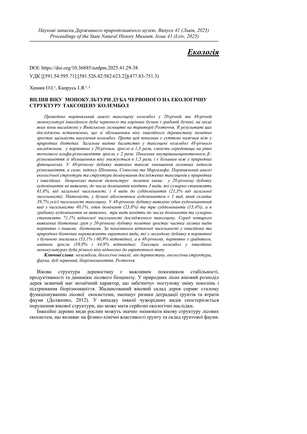
Impact of red oak monoculture age on the ecological structure of the collembola taxocene // Proc. of the State Nat. Hist. Mus. - Lviv, 2025. - 41. - P. 29-38 DOI: https://doi.org/10.36885/nzdpm.2025.41.29-38 Key words: Collembola, biological invasions, stand age, ecological structure, fauna, red oak, biodiversity, Roztocze A comparative analysis of the Collembola taxon in a 20- and 48-year-old monoculture of invasive red oak and native beech and hornbeam, which were planted in the Yaniv forestry in Roztochchia, was carried out. These studies have shown that the density of the Collembola population increases significantly with the age of the invasive stand. However, this figure is significantly lower than in natural habitats. The total species richness in the Collembola taxa of a 48-year-old stand, compared to a 20-year-old stand, increased by 1.3 times, and the habitat capacity at the level of point alpha diversity increased by 2 times. The index of intra-cenotic β-diversity decreases by 1.5 times with increasing age and is higher than in natural phytocoenoses. In the 48-year-old oak forest, a decrease in the main diversity indices, namely the Shannon, Simpson and Margalef index, was also found. A comparative analysis of the ecological structure and dominance structure of the studied taxa in natural and invasive biocenoses also shows significant changes: in the 20-year-old oak, no eudominants were found, the dominant species include 3 species that make up 61.8% of the total number, and 4 species are subdominant (21.3% of the total number). In contrast, in beech, the absolute eudominant is 1 species, which accounts for 39.7% of the total taxa. In the 48-year-old oak forest, one eudominant species with an abundance of 40.1%, one dominant (23.8%) and three subdominants (15.4%) were found, while in the hornbeam forest, no eudominants were found, three species are among the dominants and in total account for 71.1% of the relative abundance of the studied taxon. Among the four identified biotope groups, the proportion of forest species in 20-year-old oak forest is significantly increasing compared to other biotopes. In terms of relative abundance in invasive and natural habitats, eutrophic species prevail, which decreased in young oak compared to beech (53.1% and 60.9%, respectively), and increased in old oak compared to hornbeam (58.9% and 44.9%, respectively).The taxon colembolus in invasive oak monocultures of different ages is classified as eutrophic.
Impact of red oak monoculture age on the ecological structure of the collembola taxocene // Proc. of the State Nat. Hist. Mus. - Lviv, 2025. - 41. - P. 29-38 DOI: https://doi.org/10.36885/nzdpm.2025.41.29-38 Key words: Collembola, biological invasions, stand age, ecological structure, fauna, red oak, biodiversity, Roztocze A comparative analysis of the Collembola taxon in a 20- and 48-year-old monoculture of invasive red oak and native beech and hornbeam, which were planted in the Yaniv forestry in Roztochchia, was carried out. These studies have shown that the density of the Collembola population increases significantly with the age of the invasive stand. However, this figure is significantly lower than in natural habitats. The total species richness in the Collembola taxa of a 48-year-old stand, compared to a 20-year-old stand, increased by 1.3 times, and the habitat capacity at the level of point alpha diversity increased by 2 times. The index of intra-cenotic β-diversity decreases by 1.5 times with increasing age and is higher than in natural phytocoenoses. In the 48-year-old oak forest, a decrease in the main diversity indices, namely the Shannon, Simpson and Margalef index, was also found. A comparative analysis of the ecological structure and dominance structure of the studied taxa in natural and invasive biocenoses also shows significant changes: in the 20-year-old oak, no eudominants were found, the dominant species include 3 species that make up 61.8% of the total number, and 4 species are subdominant (21.3% of the total number). In contrast, in beech, the absolute eudominant is 1 species, which accounts for 39.7% of the total taxa. In the 48-year-old oak forest, one eudominant species with an abundance of 40.1%, one dominant (23.8%) and three subdominants (15.4%) were found, while in the hornbeam forest, no eudominants were found, three species are among the dominants and in total account for 71.1% of the relative abundance of the studied taxon. Among the four identified biotope groups, the proportion of forest species in 20-year-old oak forest is significantly increasing compared to other biotopes. In terms of relative abundance in invasive and natural habitats, eutrophic species prevail, which decreased in young oak compared to beech (53.1% and 60.9%, respectively), and increased in old oak compared to hornbeam (58.9% and 44.9%, respectively).The taxon colembolus in invasive oak monocultures of different ages is classified as eutrophic.
References
- Гиляров М.С. 1975. Методы почвенно-зоологических исследований. Москва: Наука. 277 с.
- Долженко В. І. 2012. Вікова структура та динаміка лісових екосистем. Київ: Фітосоціоцентр. 310 с.
- Капрусь І.Я. 1999. Значення колембол у системі біоіндикації лісових ценозів Карпат. Праці наукового товариства ім. Шевченка. Львів. Т. 3. С. 235–248.
- Капрусь І.Я., Шрубович Ю.Ю., Таращук М.В. 2006. Каталог колембол (Collembola) і протур (Protura) України. Львів. 164 с.
- Кузнецова Н.А. 2005. Организация сообществ почвообитающих коллембол. Москва: ГНО Прометей. 244 с.
- Песенко Ю.А. 1982. Принципы и методы количественного анализа в фаунистических исследованиях. Москва: Наука. 287 с.
- Проект організації та розвитку лісового господарства Яворівського національного природного парку Львівської області. Янівське ПНДВ. 2011. Таксономічний опис, відомості поквартальних підсумків. Львів. Інв. № 175/01 прим. № 2.
- Проект організації території Яворівського національного природного раку, охорони, відтворення та рекреаційного використання його природних комплексів і об’єктів. 2010. Львів. Т. 1.
- Стебаева С.К. 1970. Жизненные формы ногохвосток (Collembola). Зоол. журн. Т. 44, No 10.
С. 1437–1454. - Bellinger P.F., Christiansen K.A., Janssens F. 1996–2023. Checklist of the Collembola of the World [online]. Доступне http://www.collembola.org [Дата звернення 30 травня 2022 року].
- Funk, J. L., & Vitousek, P. M. 2007. Resource-use Efficiency and Plant Invasion in Low-resource Systems. Nature. Vol. 446(7139). – P. 1079–1081.
- Hammer I., Harper D.A.T., Ryan P.D. 2001. PAST: Paleontological Statistics Soft ware Package for Educationand Data Analysis [online]. Palaeontologia Electronica. Vol. 4, № 1. 9 p. Доступне: http://palaeo-electronica.org/2001_1/past/issue1_01.htm [Дата звернення 16 травня 2023 року].
- Havelka J., Starý P. 2007. Myzocallis walshii (Hemiptera: Sternorrhyncha: Aphididae), an exotic invasive aphid on Quercus rubra, the American red oak: Its bionomy in the Czech Republic. Eur. J. Entomol. 104: 471–477.
- MagurranA.E. 2004. Measuring Biological Diversity. Blackwell Publishing Ltd, UK. 256 pp.
- Peterken G.F. 2001. Ecological effects of introduced tree species in Britain. Forest Ecology and Management 141: 31–42.
- Pyšek P., Jarošík V., Hulme P., Pergl J., Hejda M., Schaffner U., Vilá M. 2012. A global assessment of invasive plant impacts on resident species, communities and ecosystems: the interaction of impact measures, invading species’ traits and environment. Global Change Biology 18: 1725–1737.
- Pyšek, P., & Richardson, D. M. 2010. Invasive Species, Environmental Change and Management. Annual Review of Ecology, Evolution, and Systematics. Vol. 41. – P. 71–93.
- Rédei K., Csiha I., Keserű Z., Rásó J., Győri J. 2010. Management of red oak (Quercus rubra L.) stands in the Nyírség forest region (Eastern Hungary). Hungarian Agricultural Research 3: 13–17.
- Stöcker G. Bergmann A. 1977. Ein Modell der Dominanzstruktur und seine Anwedung. 1. Modellbildung, Modellrealisierung, Dominanzklassen. Arch. Naturschutz u. Lanschafstforschung. Vol. 17, № 1. P. 1–26.
- Tischler W. 1949. Grundzüge der terristischen Tierökologie. Braunschweig, 219 s.
- Vansteenkiste D., De Boever L., Van Acker J. 2010. Alternative processing solutions for red oak (Quercus rubra) from converted forests in Flanders, Belgium. Cost Action E44 Conference in Vienna on Broad spectrum utilization of wood. Belgium.
- Woziwoda B., Kałucka I., Ruszkiewicz-Michalska M., Sławska M., Sławski M., Tołoczko W., Hachułka M., Kopeć D., Rosadziński S., Witkowski J. Interdyscyplinarne badania ekologicznych skutków introdukcji dębu czerwonego Quercus rubra L. 2012 w lasach Polski środkowej – założenia i cele projektu. Studia i Materiały CEPL w Rogowie. R. 14. Zeszyt 33 / 4 / 2012. P. 178–189.